


Before You Buy, Verify the Store.
Fake storefronts can look as polished as real retailers. Use these 12 warning signs, a practical pre-checkout workflow, and a worldwide response plan to shop with more confidence.
A stunning discount. Professional product photos. A secure-looking checkout. Five-star reviews. None of these alone proves that an online store is legitimate. Fraudulent retailers can imitate real brands, take payments for goods that never arrive, sell counterfeit items, or collect personal data. The risk exists across borders, on standalone stores, and on otherwise legitimate marketplaces.
How do you check if an online store is legit? Verify the exact domain and seller identity, compare the offer with independent retailers, look for authentic outside reviews, examine shipping and return terms, and use a payment method with a clear dispute process. If the seller pressures you to pay outside the platform or demands an irreversible transfer, stop and investigate.
This is a global consumer-safety guide. Payment protections, seller-disclosure rules, and reporting options differ by country. No checklist or automated checker can guarantee a store is safe.
The 60-Second Pre-Checkout Check
These five questions help you spot obvious concerns before you enter a card number. Tick them off while reviewing an unfamiliar seller.
12 Warning Signs of a Fake Online Store
One sign may have an innocent explanation. Patterns matter: a confusing domain combined with impossible prices, fake reviews, and unsafe payment requests is much more concerning than any one clue.
A lookalike website address
Fraudulent stores sometimes copy a brand’s appearance while using a slightly altered domain, added words, or an unexpected ending. A polished logo cannot authenticate the URL.
What to do: Find the retailer’s official website independently, then compare the full domain character by character. Don’t trust a link solely because it appeared in an ad or message.
Prices that defy comparison
An extreme discount on a scarce, luxury, or high-demand product can be bait. Fake storefronts use bargain prices to make shoppers act before verifying the merchant.
What to do: Compare the exact product model, condition, availability, shipping, and total price with several established retailers.
Pressure to buy immediately
Timers, “last item” notices, and urgent messages are not automatically scams, but constant or contradictory countdowns can be pressure tactics.
What to do: Leave the page, compare alternatives, and return later. Never let an artificial deadline replace a basic seller check.
An identity you cannot verify
Some stores provide only a contact form or messaging handle, while concealing who operates the business. Others display real-looking addresses or company numbers copied from unrelated firms.
What to do: Cross-check the trading name, location, contact information, and any business registration against independent sources or an official register where available.
Reviews that all sound the same
A wall of glowing, generic reviews proves little. Fake reviews, copied testimonials, and AI-assisted text can create the appearance of reputation.
What to do: Search the shop’s domain and business name on multiple independent platforms. Look for detailed experiences and how the seller resolves complaints.
Borrowed images or branding
High-quality photography can be reused without permission. A scam storefront may display another retailer’s product photos, name, trust badge, or return-policy artwork.
What to do: Try a reverse-image search for a distinctive product photo, and verify any claims of being an “official” or “authorized” dealer with the brand itself.
Missing delivery and refund details
Vague shipping promises, unexplained return addresses, and confusing refund terms increase risk—especially if the seller is located in another country.
What to do: Find delivery estimates, shipping fees, customs responsibilities, return windows, and who pays return postage before checking out.
Payment moved outside the platform
A marketplace seller who insists on switching to private messages, a separate payment page, or a direct transfer may be trying to bypass the marketplace’s protections.
What to do: Use the platform’s established checkout and dispute system. Decline requests to pay to an unrelated individual or account.
Only hard-to-reverse payment options
Demanding gift cards, cryptocurrency, wire transfers, or unfamiliar person-to-person payment methods is a major warning sign for ordinary retail purchases.
What to do: Prefer a payment method with clear purchase-dispute terms in your country. Do not confuse encryption or a familiar payment logo with a guarantee of buyer protection.
A history that does not match its claims
A store may claim “20 years online” even though its domain appears to have been registered recently. Domain age is useful context, not a definitive authenticity test: legitimate stores can be new and old sites can be compromised.
What to do: Check available registration data using ICANN Lookup, and compare that with independent business history and the store’s claims.
Surprise customs, delivery, or verification fees
A scammer may demand new charges after the sale, or send a fake courier message asking you to confirm payment details through a link. Legitimate cross-border orders can have import fees, so the context matters.
What to do: Verify fees with the carrier through its official website or app. Never pay via a link in an unexpected text message.
A social ad with no independent footprint
Fraudulent retailers can buy online ads or build convincing social profiles. A paid placement or influencer endorsement is not evidence that the seller was verified.
What to do: Search the retailer’s domain, history, and complaints separately. Visit its official account independently rather than relying on the advertisement.
https:// means the connection is encrypted; it does not establish that the seller is honest, has stock, or will honor refunds. A clean automated safety check is helpful but cannot prove that a merchant is legitimate. See the official guidance below.A Worked Example: The Too-Good-to-Be-True Headphones
This is a fictional scenario to demonstrate the method—not a claim that we audited a real store.
Imagine finding premium wireless headphones at 70% below the price at established retailers. The store looks professional and says the offer expires in 12 minutes.
The retailer claims to be a long-established outlet, but the publicly available domain record suggests a very recent registration. No matching corporate details are independently confirmed.
Nearly all reviews repeat the same vague praise. The product photo also appears on unrelated websites.
Shipping is described as “fast worldwide,” but no precise delivery estimate, customs information, or usable return address appears.
At payment, the seller asks for a direct transfer to a personal account rather than a standard retail checkout.
Editorial conclusion: The combined signals create a substantial reason to avoid this purchase. We do not need to label the seller criminal to make a safer decision: choose an independently verifiable retailer instead.
Which Warning Signs Are Strong Evidence—and Which Are Just Clues?
Not every suspicious detail carries the same weight. A new domain, limited reviews, or an unfamiliar website design may justify more research, but none proves that a store is fraudulent. Look for independent confirmation and patterns of risk.
| What You Check | What It Can Tell You | What It Cannot Prove |
|---|---|---|
| HTTPS and the padlock | The connection to the website is encrypted. | That the seller is honest or will deliver your order. |
| Domain registration date | A recently registered domain may deserve additional scrutiny. | That a new store is fraudulent or an older domain is safe. |
| Customer reviews | Independent reviews may reveal patterns involving delivery and customer service. | That every review is authentic or that every buyer will have the same experience. |
| Business registration | Official records may help verify that a business exists. | That the website actually belongs to that business. |
| Payment outside the platform | Pressure to use an irreversible transfer can be a serious warning sign. | Fraud by itself, although it may be sufficient reason not to proceed. |
Imagine an unfamiliar electronics store offering a popular product at an unusually low price. The domain was registered recently, the listed company cannot be independently connected to the website, and the seller insists on payment by direct bank transfer.
The domain’s age alone would not prove fraud. But combined with an unverifiable seller and an irreversible payment request, the risk is substantially more concerning. A sensible decision is to avoid the transaction and choose an independently verifiable retailer.
Illustrative scenario, not a test of a real store.
Three Useful Tools—and Their Limits
Use external evidence to test specific claims. None of these services certifies a shop as trustworthy.
FREE INTERACTIVE TOOL
Check an Online Store with StoreCheck
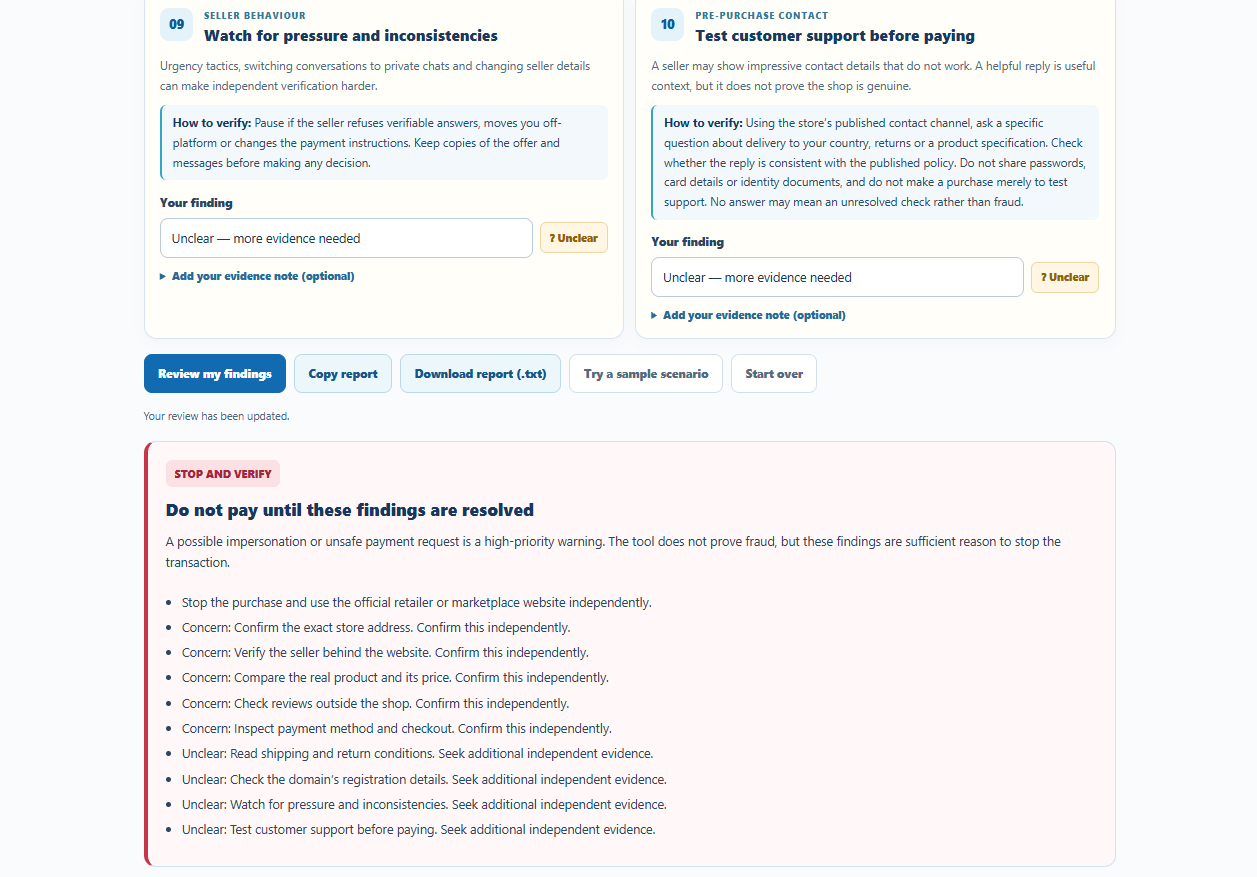
Put this guide into practice with our free 10-step online store safety checker. Review seller details, payment risks, customer support, and other warning signs before you buy. StoreCheck is a guided research tool, not an automated fraud detector or a safety guarantee.
Try StoreCheck — Free Safety Checker →StoreCheck in action: This illustrative example shows how a guided review organizes warning signs and unresolved questions. Multiple concerns lead to a recommendation to stop and verify the seller before paying.
How to read domain registration details: The example below shows a real ICANN Lookup result for example.com, a domain reserved for documentation. Look for the creation date, registration status, and registrar information. These details provide useful context, but they cannot establish whether an online store is legitimate.
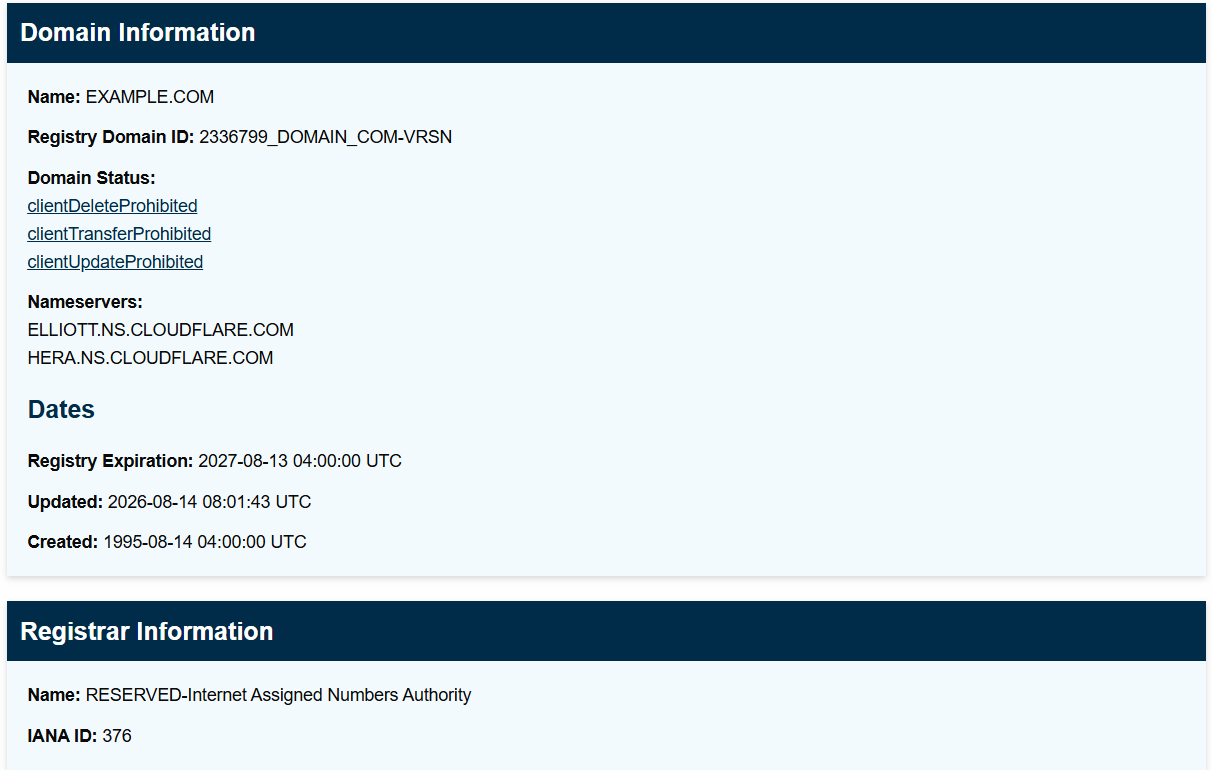
View available domain-registration information for many domain types. Some ownership details may be redacted and new domains can be legitimate.
Check domain registration ↗Check whether Google currently identifies a URL as unsafe. No warning is not a merchant certification or a guarantee against shopping fraud.
Check site safety status ↗Search the exact domain and store name plus terms such as “complaint,” “refund,” or “scam.” Compare independent evidence rather than trusting one review page.
Research the seller ↗Which Payment Choices Are Safer?
The practical question is: if the goods never arrive, what documented dispute or recovery route do you have? Exact rights depend on the country, bank, network, and service terms.
| Payment route | What to check | Main caution |
|---|---|---|
| Credit card | Dispute/chargeback process offered by your issuer | Eligibility, deadlines, and rules vary by jurisdiction |
| Marketplace checkout | Published buyer-protection and claims policy | Protection can disappear when you pay outside the platform |
| Debit card or digital wallet | Issuer or provider’s purchase protection and dispute terms | Not all card types, transfers, or wallet transactions receive equivalent protection |
| Bank transfer, crypto, gift card | Whether any recovery method exists before sending funds | Frequently difficult or impossible to reverse after payment |
Never send one-time passcodes, banking passwords, or identity documents simply because a seller requests them in chat. For the exact protection attached to your payment method, consult your financial institution or the marketplace’s official policies.
What to Do If You Already Paid a Suspicious Store
Act promptly. The goal is to protect your funds and accounts while preserving evidence.
Contact the payment provider immediately. Use your bank or card issuer’s official phone number or app. Explain what you paid, why you suspect fraud, and ask about a dispute, payment recall, or card replacement as appropriate.
Preserve the evidence. Save the exact URL, order page, confirmation emails, chats, receipts, promised delivery dates, and any tracking information. Do not delete messages before recording them.
Protect your accounts. If you reused a password, change it on the affected and other relevant services; enable multi-factor authentication. If you entered payment credentials, ask your bank how to secure your account.
Use the retailer or marketplace’s legitimate dispute channel. If you ordered through a genuine platform, open a case inside that platform. Be skeptical of anyone demanding a separate “recovery fee.”
Report the incident locally. Contact your national consumer-protection or cybercrime authority, and local police when appropriate—even if the seller appears to be abroad. INTERPOL advises individuals to report crimes through local police, not directly to INTERPOL.
Frequently Asked Questions
Does HTTPS or the padlock icon mean an online store is legitimate?
No. HTTPS indicates an encrypted connection, not the honesty, identity, or reliability of a seller. Fraudulent websites can use HTTPS too. Always verify the retailer separately.
Can a brand-new online store be legitimate?
Yes. A recently registered domain is context, not proof of fraud. Combine registration data with evidence about the business, payment terms, independent reviews, and contact details.
Are sponsored ads and social-media shops verified?
Do not assume a paid ad or social profile authenticates the merchant. Scammers may purchase advertisements or impersonate brands. Search for the seller independently and inspect the destination domain.
Can AI tools or website-checker services guarantee safety?
No. Automated services can flag known threats or suspicious patterns, but they can miss new scam stores, make mistakes, or lack information about whether orders will be fulfilled. Use multiple independent checks.
What if the seller is in another country?
Check the legal seller, return location, customs fees, and applicable consumer rights before paying. Cross-border recovery may be more difficult, and the protections available to you depend on the countries and payment method involved.
What is the single biggest reason to stop a purchase?
There is no universal one-sign test, but being pressured to send money via hard-to-reverse methods—or to leave a trusted marketplace’s payment system—is a particularly strong warning to stop and verify.
Original Guidance and References
This guide draws on public advice from several regions rather than applying one country’s consumer laws to the whole world. Links were reviewed for this editorial draft on October 26, 2026.
- INTERPOL — Shop safely. Retailer details, refunds, counterfeit goods, and reporting concerns.
- UK National Cyber Security Centre — Shopping and paying safely online. Fake stores, suspicious links, safer shopping.
- Australian Scamwatch — Buying and selling scams. Seller identity, payment methods, prices, marketplace fraud.
- Singapore ScamShield — E-commerce scams. Off-platform payments, fake delivery fees, seller impersonation.
- New Zealand Consumer Protection — Check before you buy online. Independent reviews, total price, payment, international orders.
- US Federal Trade Commission — Online Shopping. Researching sellers, payment disputes, HTTPS limits, keeping records.
- European Commission — Protecting you when buying online. Regional consumer rights and actions following scams (rights are not universal worldwide).
- ICANN — RDAP and domain registration lookup. Understanding public domain-registration data and its limitations.
- INTERPOL — If you need help. Why international crimes should be reported to local police.
Check the Seller. Check the Payment. Then Decide.
Never let a beautiful storefront or a countdown timer make the decision for you. A few independent checks can reveal warning signs before you hand over money or personal information. When evidence is missing, walking away is a valid choice.
Editorial transparency: This is an educational synthesis of public consumer-protection guidance, not a ranking of retailers or a controlled study. The worked example is fictional. No online store is guaranteed safe by this checklist. Local laws and financial protections vary. The Circuit Edit does not request payment information on this page.