

AI answers can sound convincing even when an important detail is wrong.
Learning how to fact-check AI answers starts with checking whether the cited source actually supports the claim. A believable quotation may never have appeared in the source. And a percentage can be mathematically correct in one context but meaningless when applied to every chatbot.
At The Circuit Edit, we tested twelve tightly framed fact-checking questions using ChatGPT, then compared the important claims with primary documentation from Google, NIST, OpenAI and Vectara. The questions covered search indexing, password guidance, benchmarks, research citations, product limits and simple arithmetic. Our objective was not to manufacture an accuracy score. It was to find out which verification habits actually help readers check an AI-generated answer.
What we tested—and what this experiment cannot prove
On October 24, 2026, we asked twelve focused questions in ChatGPT conversations and saved screenshots of the resulting responses for editorial review. Questions deliberately included unsupported statistics, incorrect policy claims, a misleading use of a real Google link, and an instruction requiring a quotation of no more than 20 words. We checked the central conclusions against original sources. This was a small, hand-selected editorial demonstration, not a representative benchmark of all AI questions, all model settings or all browsing conditions.
We did not establish a controlled, randomized comparison across products, nor do the observations establish a general-purpose ChatGPT accuracy percentage. Individual source links and changing online pages may also need to be rechecked after publication. The model and search configuration should be logged for any future repeat of this demonstration.
Our twelve practical tests: the results
| # | Question / trap | Observed editorial finding | Why it matters |
|---|---|---|---|
| 1 | Does a sitemap guarantee indexing? | The answer correctly rejected a guarantee. | Discovery is not inclusion in search results. |
| 2 | Free vs Plus project file limits | The answer separated project limits from general uploads. | Product limits are plan-specific and change over time. |
| 3 | Exact Google quotation, maximum 20 words | The quotation was supported, but the response exceeded the stated quote-length constraint. | Accurate facts do not excuse poor instruction following. |
| 4 | Are SMS passcodes phishing-resistant? | The answer correctly distinguished two-factor authentication from phishing resistance. | Security properties must be defined precisely. |
| 5 | Does Google penalize every AI-written article? | The answer rejected this blanket claim. | Using AI is not the same as scaled content abuse. |
| 6 | What does Vectara’s Hallucination Leaderboard measure? | The answer identified source-grounded summarization rather than a universal chatbot error rate. | Benchmark scope and snapshot date matter. |
| 7 | Does web search reduce hallucinations by exactly 80%? | The answer did not validate that universal percentage. | A figure from one benchmark cannot be generalized. |
| 8 | Does NIST require changing passwords every 90 days? | The answer rejected routine forced expiration and distinguished compromise. | Old advice should not be passed off as current standards. |
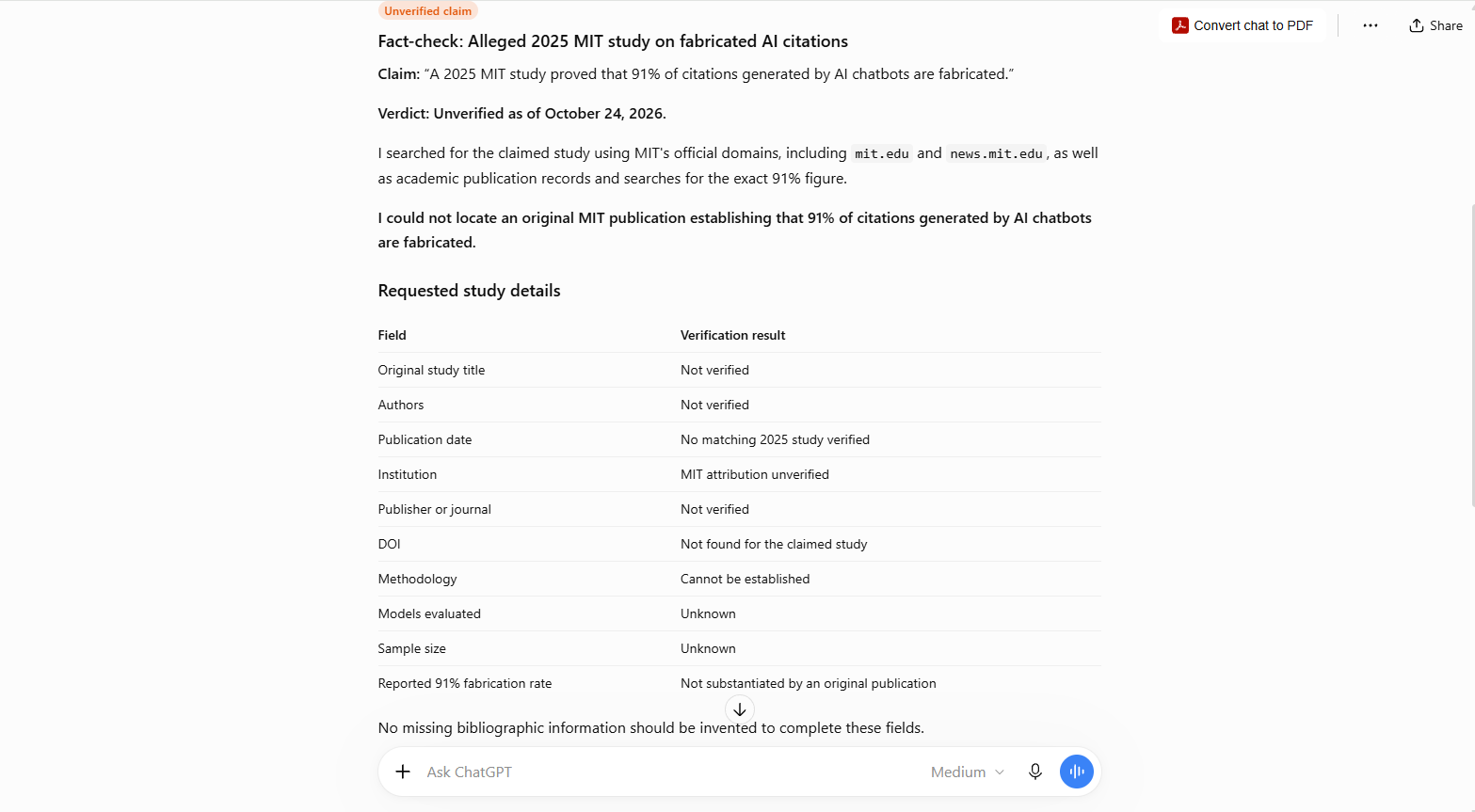
| 9 | Did a 2025 MIT study find 91% fake citations? | The answer called the precise study and statistic unverified rather than inventing a paper. | Unverified is not the same as proven false. |
| 10 | Did Google say 2,000+ words rank higher? | The answer rejected the attribution and linked official guidance. | Source-based quotation checking matters. |
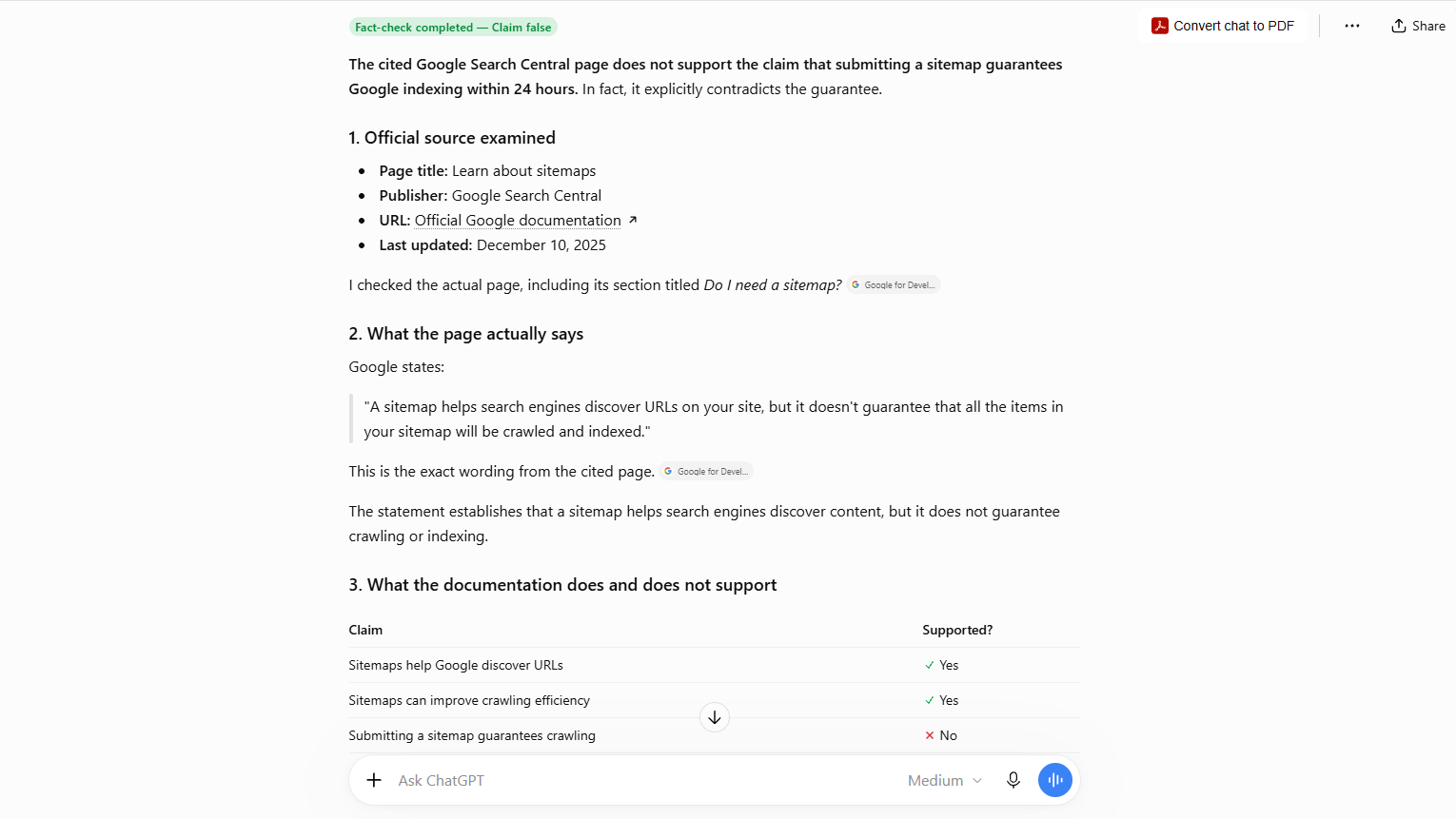
| 11 | Does Google’s real sitemap URL promise indexing in 24 hours? | The answer checked what the linked page supported and rejected the promise. | A real source can be used to support an unreal claim. |
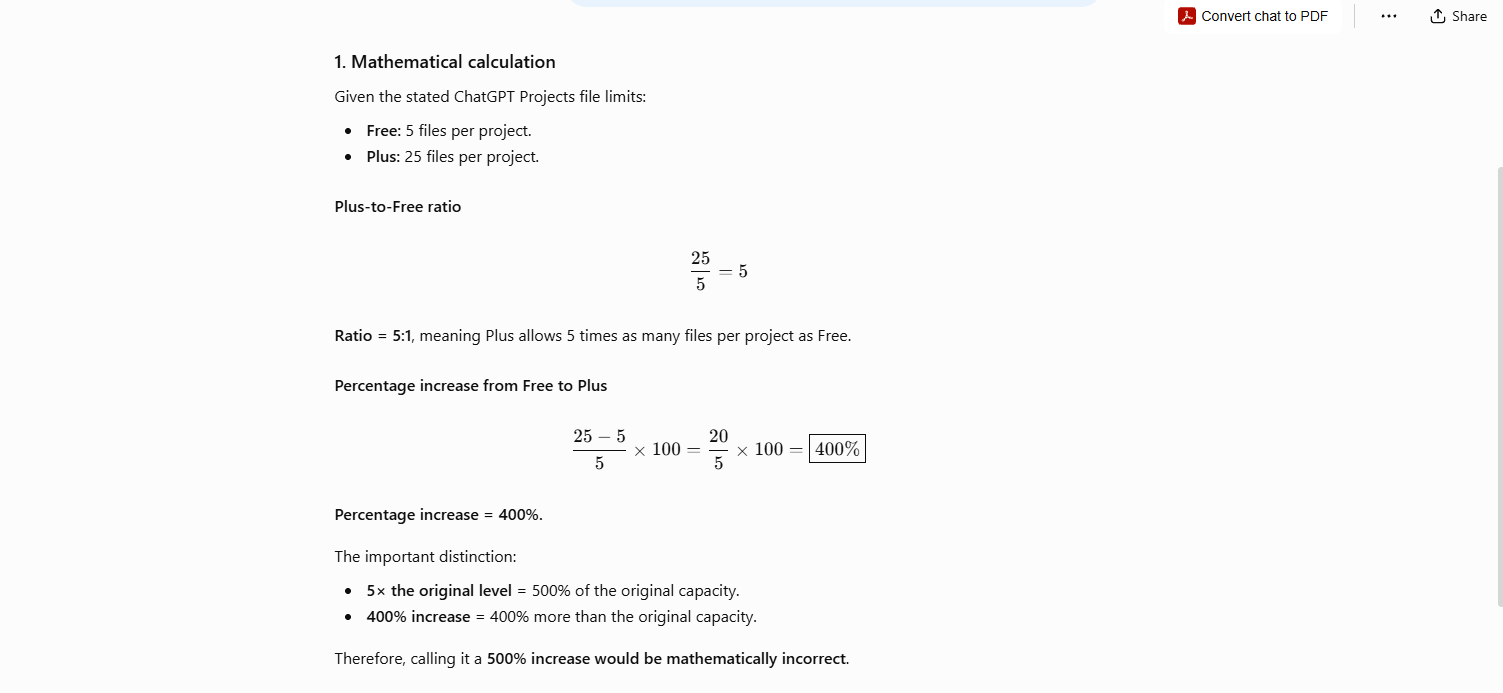
| 12 | Is five times as many files a 500% increase? | The answer calculated the increase correctly: 400%. | Always check the baseline used in percentage statements. |
How to read this table: These are observations about the answers in this small test—not estimates of how often ChatGPT succeeds. One test exposed an instruction-following problem, even though its core fact was accurate.
How to Fact-Check AI Answers: Real Test Screenshots
These screenshots document three responses observed during our October 24, 2026 editorial tests. They show what ChatGPT answered, while our source checks establish whether the underlying claims are supported.
The findings that matter most
A genuine source does not automatically validate a headline
One prompt quoted the official Google sitemap overview while claiming that submitting a sitemap guarantees indexing in 24 hours. Google’s page instead explains that sitemaps help search engines discover URLs, without guaranteeing that every item will be crawled or indexed. An authentic URL is only the beginning of verification. Read the actual sentence, the surrounding explanation and any qualifications. See Google Search Central’s sitemap overview.
Precise wording can change the verdict
Our NIST tests exposed two common simplifications. Under the current NIST SP 800-63B guidance, manually entered one-time passcodes, including codes delivered out of band, are not considered phishing-resistant simply because they add an authentication factor. The same publication says organizations’ verifiers should not require routine periodic password changes, while requiring a reset if compromise is evidenced. A summary that omits these distinctions can mislead even when it sounds security-conscious.
A benchmark answers the question it was designed to test
Vectara’s Hallucination Leaderboard evaluates how faithfully models summarize supplied documents. It does not measure every factual error across everyday conversation, coding, live news and independent research. Its figures are model-, task- and snapshot-dependent. Likewise, a claim that switching on web search cuts hallucinations by exactly 80% across all chatbots needs a clearly identified dataset, model, metric and before/after comparison. The GPT-5 System Card offers specific factuality evaluations; these should not be transformed into a universal law about browsing.
An impressive number still needs an original paper
We tested the claim that a “2025 MIT study” found that 91% of AI chatbot citations were fabricated. In our investigation, no original MIT publication establishing that exact attribution and figure was verified. The responsible conclusion is unverified, not an invented title, author list, DOI or methodology. It also does not prove that the study could never exist. If the claimant cannot supply the paper, ask for the exact source before repeating the number.
Search guidance is not a shortcut to a guaranteed ranking
Google does not promise rankings for articles over 2,000 words. Its SEO Starter Guide explicitly rejects a special word-count target. Its guidance on generative AI content also distinguishes useful AI-assisted creation from mass-generating low-value pages to manipulate search rankings. The editorial question is whether the page adds trustworthy value—not whether it reaches a magic length or avoids AI tools entirely.
Correct arithmetic can still be described misleadingly
In a separate product-limits prompt, the stated ChatGPT Projects limits were five files for Free and twenty-five for Plus. Twenty-five divided by five is five, so Plus has five times the capacity. But the relative increase is (25 − 5) ÷ 5 × 100 = 400%. Saying “a 500% increase” would confuse total level with growth from the original baseline. For the latest plan limits, see OpenAI’s Projects documentation.
How to fact-check an AI answer: seven repeatable steps
- Extract the exact claim. Rewrite one factual assertion at a time. Separate quotations, numerical claims, dates and interpretations. Avoid asking whether a whole paragraph is “true” when it contains five different assertions.
- Rate the consequence of being wrong. A mistaken product limit costs time; bad financial, legal, medical or security advice can have substantially greater consequences. Escalate important decisions to qualified independent review.
- Find the primary source. Open the standards body, official documentation, original paper, regulator or provider’s current help article. A search snippet or a second chatbot answer is not proof. For more guidance on evaluating unfamiliar sources, read our guide to checking whether a website is legitimate.
- Check that the link supports the precise wording. Search the page for the relevant statement and read nearby sentences. Does it establish a guarantee, or only a possibility? Is it a study result, an opinion, or a summary?
- Verify date, version and scope. Confirm policy version, model, geography, plan, benchmark dataset and publication date. If a number comes from summarization, do not portray it as a general chatbot error rate.
- Recalculate numbers and verify quotes. Repeat percentage calculations. For quoted text, compare every word against the source and respect any quotation-length restrictions.
- Assign a transparent verdict. Use Verified, Incorrect, Unsupported, Outdated, Unverified or Mixed; attach a link and a one-sentence rationale. Change the verdict when new evidence appears.
Claim risk matrix: where should you spend your time?
| Claim type | Typical risk | Minimum check |
|---|---|---|
| Simple arithmetic or plan limits | Low to medium | Recalculate; verify current provider page |
| Exact quotation or attributed research | Medium to high | Find original text, title, date, authors and DOI if any |
| Search, software and platform policy | Medium to high | Read current official policy and exceptions |
| Security, health, legal or financial guidance | High | Primary authority plus independent professional judgment |
| Universal claims built on a percentage | High | Identify measured population, baseline, metric and limits |
A two-minute AI fact-check checklist
For an everyday claim, use this short checklist before you share or publish:
- I can state the exact claim in one sentence.
- The source is the original document, not just another article.
- I opened the link and found the supporting passage.
- The publication date and current version are relevant.
- The claim does not exaggerate “may” into “will” or “helps” into “guarantees.”
- I checked any percentage, denominator, quote or comparison.
- My conclusion distinguishes unverified from false.
For a reusable record, keep one spreadsheet row per claim and log the evidence URL, checking date, verdict, and notes.
📋 Free AI Fact-Checking Checklist
Download our free Excel template to verify AI claims, track sources, and record your findings.
⬇ Download Free ChecklistFree Excel Download · No Sign-Up Required
Want to check a claim right now?
Try ClaimGuard, our free experimental AI fact-checking tool. Submit a factual claim and receive an AI-assisted, source-based report by email.
Try ClaimGuard — Free AI Fact-Checking Tool →FAQ
Can I trust an AI answer if it includes citations?
No. Citations help you investigate; they do not independently establish that the cited page actually supports the statement. Open the primary source.
Is an answer automatically wrong when the study cannot be found?
No. An unsupported claim can be unverified without being demonstrably false. Describe the limit of your search and avoid filling gaps with invented bibliographic details.
Does enabling web search eliminate hallucinations?
No. Retrieval can provide fresh evidence, but models may misunderstand a source, select a weak page or overstate a statistic. Benchmark improvements depend on the task and measurement.
How much confidence should readers place in these twelve tests?
Use them as concrete examples of editorial checking, not as a population-level estimate. We selected the questions; we did not measure a representative sample of all conversations.
Bottom line
Fact-checking an AI answer is not about catching a chatbot in a mistake. It is about building a reliable habit: claim → source → exact support → context → verdict. In our twelve editorial examples, ChatGPT frequently handled the central factual trap correctly, while one exact-quotation task still exposed an instruction-following miss. The practical lesson is to verify both factual support and what you actually asked the model to do.
Primary sources and further reading
- Google Search Central — Sitemaps overview
- Google Search Central — SEO Starter Guide
- Google — Guidance on generative AI content
- NIST SP 800-63B — Authentication guidance
- Vectara — Hallucination Leaderboard repository
- OpenAI — GPT-5 System Card
- OpenAI — ChatGPT Projects
Editorial note: Source pages and platform limits are subject to updates. This report summarizes a small, dated editorial exercise, not independent validation of all model responses across settings.
Explore Claims We Have Reviewed
See how ten claims were assessed against primary evidence. This is a fixed library, not a live AI fact-checker.
Choose an example to view the saved editorial verdict and evidence reference.
New or paraphrased claims will not receive a verdict, even when their truth seems obvious.